Saipem plays a nodal role in the value chain, positioned between clients and a large, global base of vendors, including subcontractors, suppliers, and business partners. Managing Saipem’s supply chain – around 20,000 vendors and 1,758 product and service categories – requires a highly structured system. We apply an integrated supplier life-cycle approach, covering qualification, bidding, contract execution, and performance feedback, gradually embedding sustainability requirements alongside technical and commercial criteria. This model combines standardised procedures applicable to all vendors with dedicated procedures for suppliers providing critical material and services. Our vision is to lead by example, recognising that progress on climate and environment, safety, human and labour rights, and business ethics depends also on suppliers’ performance and on our ability to set clear expectations and support improvement.
Saipem has been fully committed to sustainability topics for a long time and is confirming its intention to play a leading role on this topic because we want to be recognized as an advanced technological and engineering platform for a sustainable future.
Making strides on driving impact through a responsible supply chain
| 2025-2028 Objectives | Target Year | 2025 Results | Progress |
|---|---|---|---|
|
Scope 3 short-medium term targets definition - Expand the number of vendors registered on Carbon Tracker and strengthen the information and data available on the platform |
2025 |
121 vendors registered out of the 263 top emitting vendors engaged on Carbon Tracker identified through delivered material volumes, representing over 80% of the material volumes expected from the highest emission-intensity categories |
100%7777
|
| Strengthen Human Rights in Supply Chain |
2025 |
67% subcontractors (122) trained out of 183 identified; accounting for 20% total ordered and 55% ordered from high-risk vendors |
100%7777
|
|
Strengthen Human Rights in Supply Chain |
2025 |
5 audits executed to high-risk subcontractors operating in China (1), United Arab Emirates (3) and Qatar (1). The 5 vendors represent 8% of total ordered and 23% of total ordered from high-risk vendors |
50%7777
|
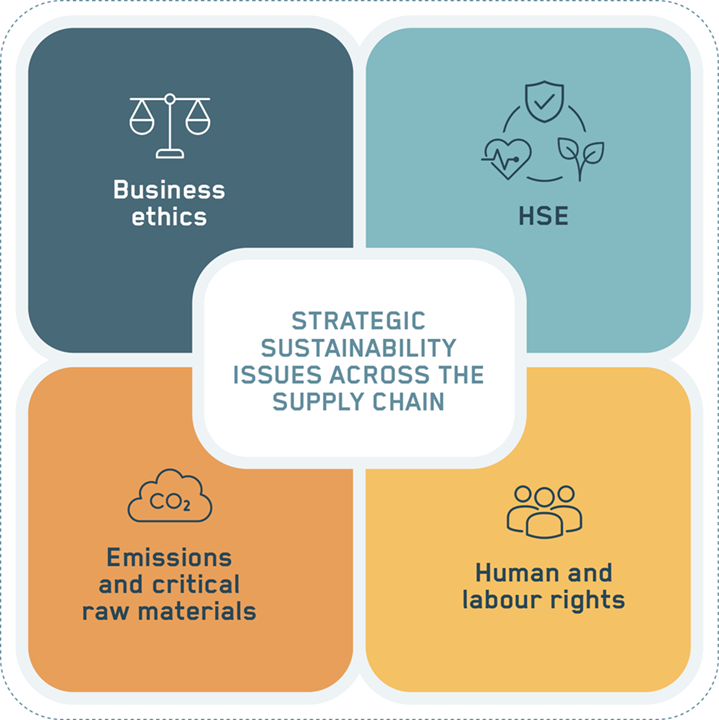
Supply chain and strategic sustainability issues
Beyond general supply chain management principles, Saipem adopts specific strategies and approaches across crucial thematic areas such as emissions and critical materials, HSE, human and labour rights, and business ethics.
Discover more