
Our innovation strategy blends energy transition and environmental sustainability goals with a commitment to advanced technologies to address global challenges. We seek to leverage innovative technologies to reduce the carbon footprint of projects and meet increasingly stringent technical and economic demands, while investing in the energy transition to achieve even broader sustainability goals, for example through water management and circular economy initiatives. Our priorities include CO₂ capture and reuse technologies (CCUS), renewable energy solutions like offshore wind and geothermal energy, low carbon and advanced nuclear technologies.
Technology is the key to successfully tackling the decarbonisation of hard-to-abate sectors. Our ambition is to integrate processes and technologies, providing clients with an end-to-end decarbonized solution in line with their Net Zero target.

Making strides in Innovation
Seeing progress
A look at where we are at with our objectives on Innovation
INNOVATION TARGETS AND PERFORMANCE
| 2025-2028 OBJECTIVES | TARGET YEAR | 2025 RESULTS | PROGRESS |
|---|---|---|---|
|
Increase TRL (Technology Readiness Level - NASA Scale) for key technologies for energy transition |
2026 |
Ongoing actions to TRL increase for 3 technologies. | On track |
| Measuring Value with Innovation | 2026 | 3 projects/technologies analysed through the TechInnoValue model | On track |
| Technology Risk Analysis | 2027 | 21 Technology Risk Analysis completed and 5 ongoing: target achieved in 2025 | On track |
How we use technology to drive sustainable innovation
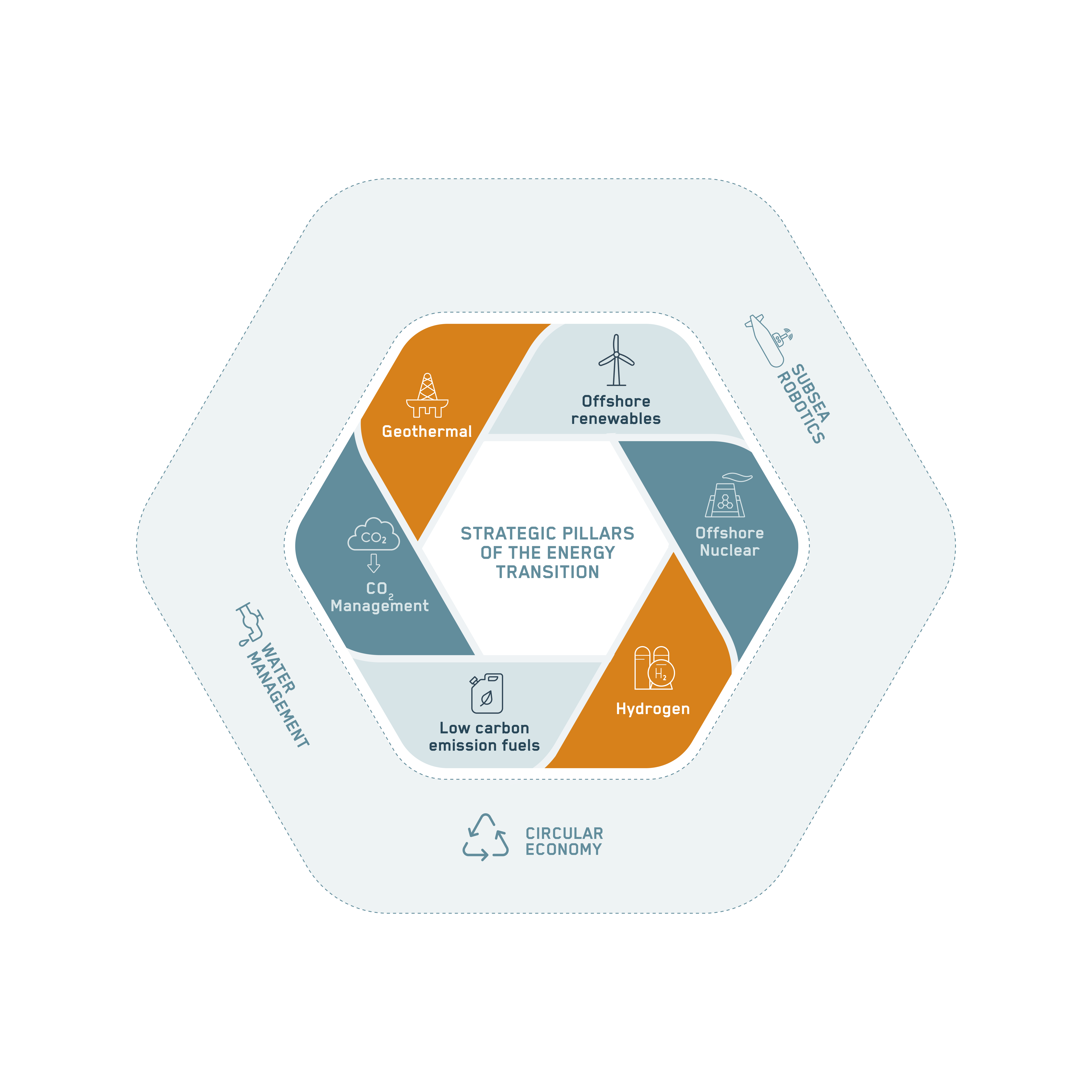
Six strategic pillars—geothermal, offshore renewables, offshore nuclear, CO₂ management, hydrogen and low-carbon emission fuel—guide us in developing and implementing technologies for the energy transition. Furthermore, three areas—subsea robotics, circular economy and waste management— play a vital role in supporting the push towards the energy transition. We have also built an extensive network of companies, universities, spin-offs, start-ups and research centres with which we collaborate to develop hydrogen technology projects.
Discover more