
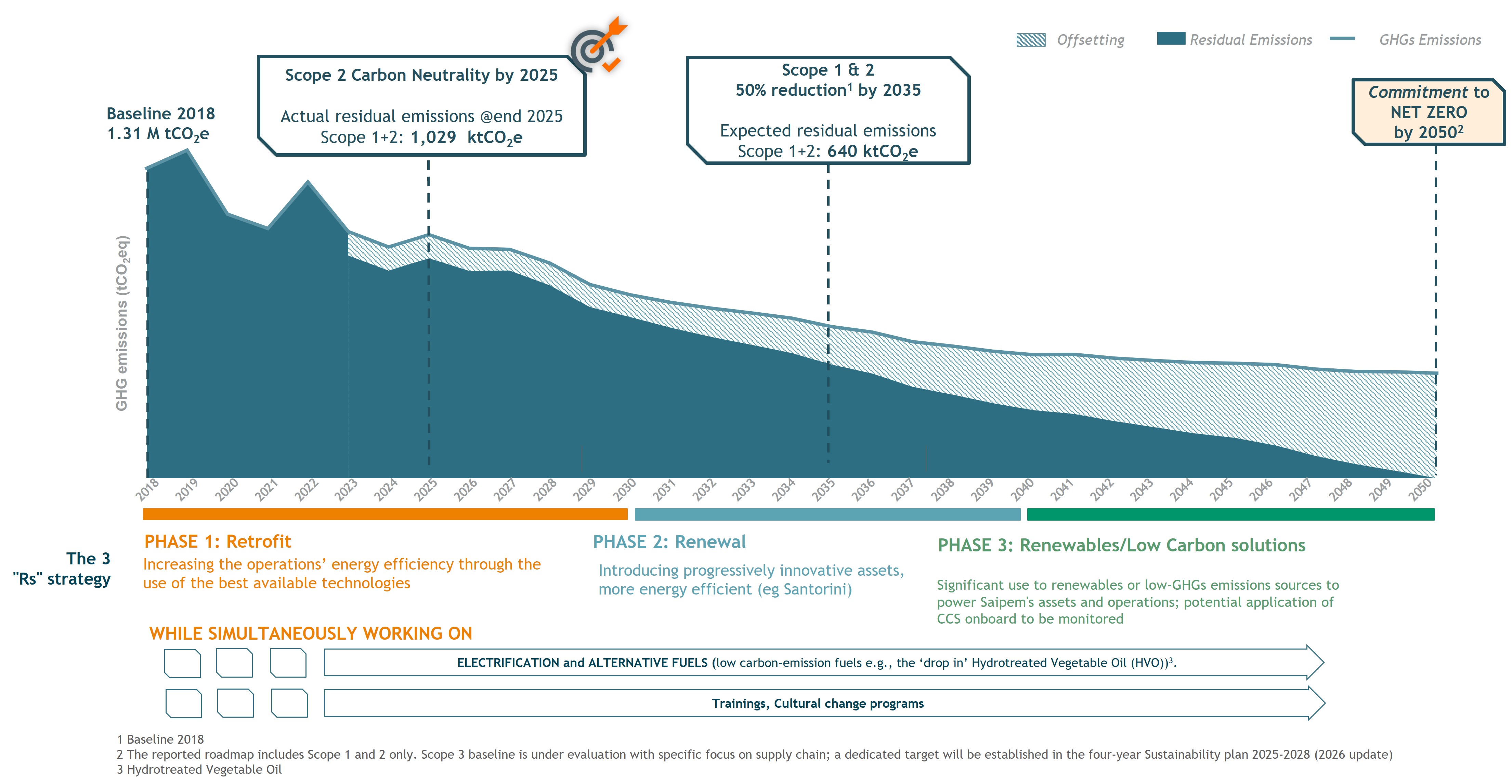
We are committed to reducing our carbon footprint while driving the global energy transition. Our approach prioritises direct emission reduction across operations, while also supporting our clients in their own decarbonisation journey. Our commitment is to achieve Net Zero through Scope 1, 2 and 3 greenhouse gas (GHG) emissions by 2050, with intermediate target to halving Scope 1 & 2 emissions by 2035.
We’ve already achieved carbon neutrality for Scope 2 through energy savings and efficiency initiatives, the use of renewable energy sourced from the grid or self-generated, and the offsetting of residual emissions.
At Saipem, the transformation towards decarbonization is not a solitary journey: it is a shared process, fueled by collaboration with all the players in our value chain. We drive change and are, in turn, driven by it—through ongoing dialogue that helps us identify concrete and innovative solutions. The Net Zero Programme reflects our commitment to integrating sustainability into operations, with clear goals and measurable progress
Making strides towards net zero

Seeing progress
A look at where we are at with our Decarbonisation objectives
DECARBONISATION TARGETS AND PERFORMANCE
Saipem has the commitment to achieve the Net Zero throughout Scope 1, Scope 2 and Scope 3 by 2050, by means of intermediate targets, enabled by a combination of short‑ and long‑term targets.
| 2025-2028 OBJECTS | TARGET YEAR | 2025 RESULTS | PROGRESS |
|---|---|---|---|
|
Scope 1 and 2 – A 50% reduction in Scope 1 and 2 emissions compared to 2018 |
2035 |
Residual emissions at end of 2025: 1.029 kt CO2 eq (Scope 1+2). |
50%7777
|
| Scope 2 Carbon neutrality |
2025 |
Scope 2 Carbon neutrality achieved |
50%7777
|
| Scope 1&2 - GHGs emissions avoided due to energy management initiatives |
2025 |
Emissions avoided at end of 2025: 82.582 t CO2 eq |
50%7777
|
| GHGs emissions compensated thanks to Saipem offsetting strategy in 3 years | 2023-2025 | 300 kt CO2 eq emissions compensated since 2023 |
50%7777
|
Our roadmap to decarbonisation
Our decarbonization strategy has two main pillars. First, we are committed to reducing our footprint across assets and operations (throughout Scope 1–2, and 3), In the long term we have the commitment to achieve Net Zero by 2050, with clear and tangible milestones:
- implementing energy management initiatives to reduce annually Scope 1 and 2 GHG emissions;
- halving Scope 1 and 2 emissions by 2035;
- achieving carbon neutrality for Scope 2 emissions by 2025;
- participating in offsetting projects “beyond our value chain”, selected for their co-beneficial effects on communities, biodiversity and ecosystems
Second, we are focused on supporting our clients to help them reduce their emissions by proposing and facilitating low GHG emission solutions, while delivering low carbon technologies to the market (as CCS, hydrogen, plastic recycling).
Our key projects are what turn our Net Zero strategy into concrete action, addressing decarbonisation through complementary but clearly differentiated approaches. On one hand, avoided emissions are achieved within Saipem’s activities and value chain through a combination of energy savings, energy efficiency measures and the use of renewable energy, contributing to the reduction of operational emissions. On the other hand, BECCS‑based solutions reflect Saipem’s role as an engineering and technological enabler, supporting the actual removal of biogenic CO2 from the atmosphere at system level. While not reducing Saipem’s own emissions, these projects contribute to global decarbonization pathways by enabling negative emissions on an industrial scale. Together, these approaches illustrate Saipem’s role in facilitating the decarbonization pathway within and beyond its value chain.
Reducing our footprint across assets and operations
We avoided 82.6 kt of CO₂ eq GHG emissions through the implementation of energy management and efficiency initiatives. These included enhanced monitoring practices, the extension of energy‑saving measures onboard vessels and rigs, and the increased use of biofuels. Additional emission reductions were achieved by connecting yards to the local electricity grid, optimising generator operations, procuring electricity from renewable sources certified through Guarantees of Origin and I‑REC certificates, and upgrading lighting, heating, ventilation, and air conditioning (HVAC) systems.

Supporting our clients’ decarbonisation journey
For our clients, assist them in reducing their carbon footprint by proposing and facilitating low GHG emission solutions, while delivering low carbon technologies to the market.
Our range of technological solutions supporting decarbonisation and the energy transition include CCUS, geothermal, clean energy carriers (hydrogen, ammonia and low-emission fuels), low-carbon chemicals, chemical recycling and offshore renewable infrastructure.
Stockholm Exergi BECCS initiative: enabling negative emissions
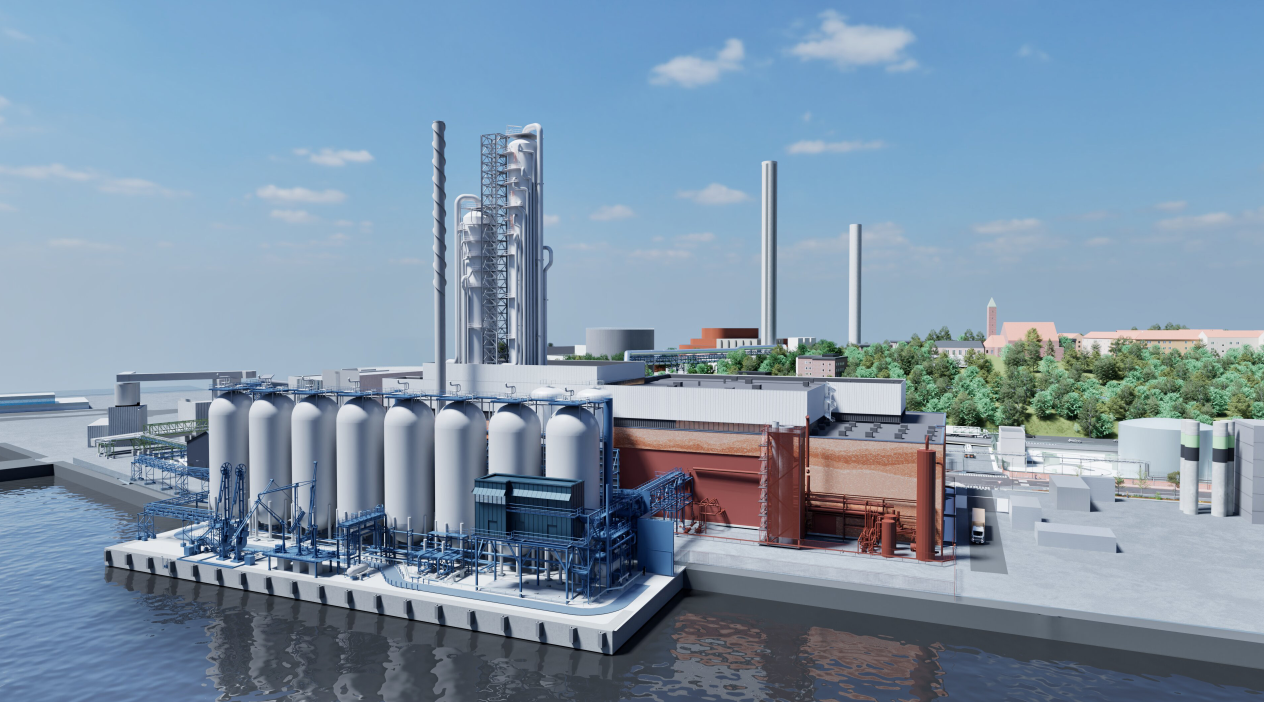
Stockholm Exergi’s large-scale BECCS project is among the world’s largest bioenergy carbon capture initiatives. We contribute to the engineering, procurement, construction, and commissioning of a CO₂ capture plant at the Värtaverket biomass facility in Sweden, which will capture 800,000 t of biogenic CO₂ annually, storing it safely under the North Sea seabed, generating annual negative emissions equivalent to 800,000 carbon credits.
Castorone: advancing lower-emission offshore operations
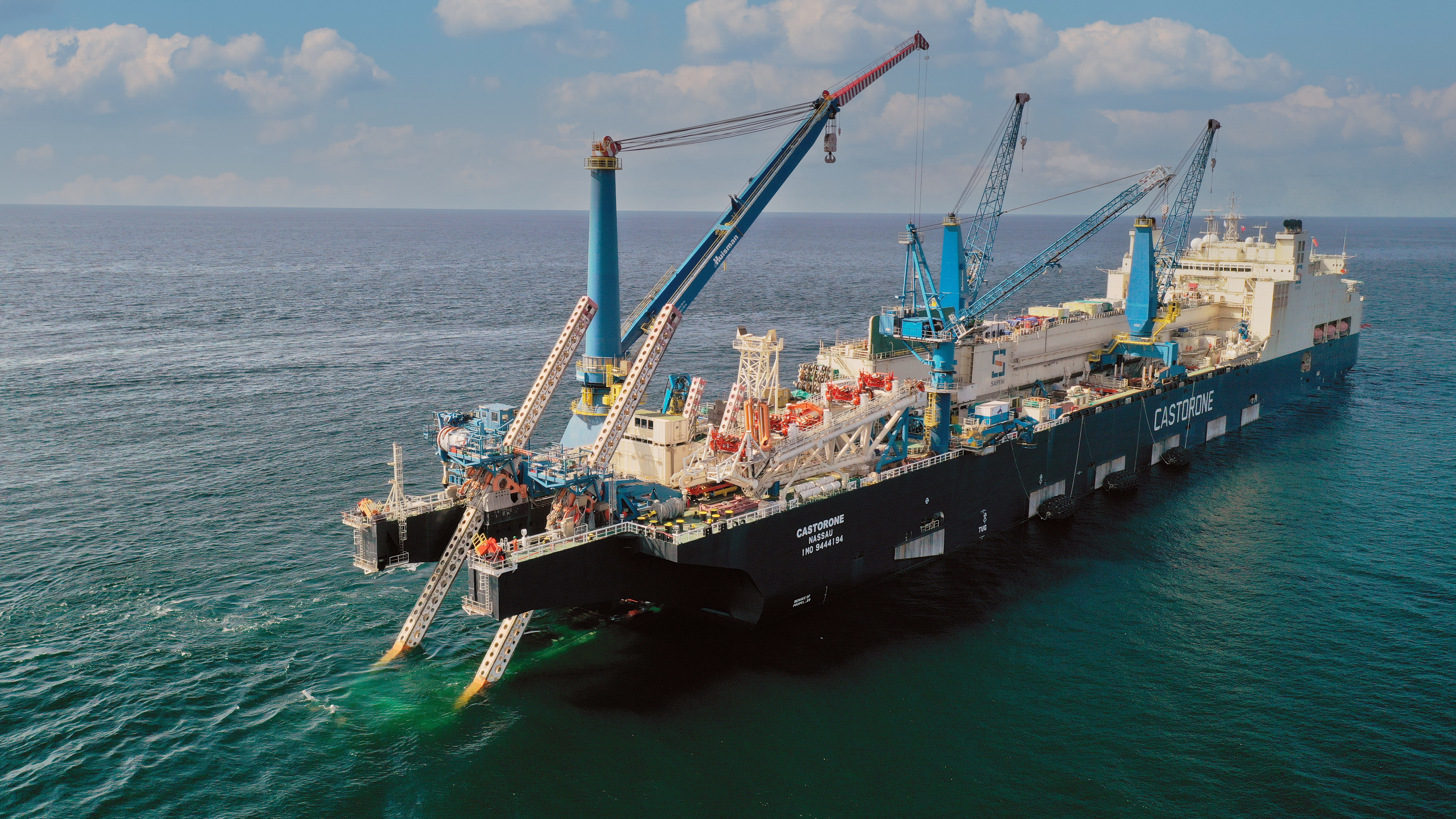
Castorone, a flagship offshore vessel, is a testbed for reducing emissions from existing assets. In 2025, it advanced operational decarbonisation through Saipem Eco-Operations, an operational approach that combines standardised procedures, digital dashboards and crew engagement to improve fuel efficiency and reduce energy use in offshore activities, and it was prepared to operate with hydrotreated vegetable oil (HVO), a drop-in biofuel, supporting Saipem’s fuel-transition strategy.
The story of James Derrick Alfonso
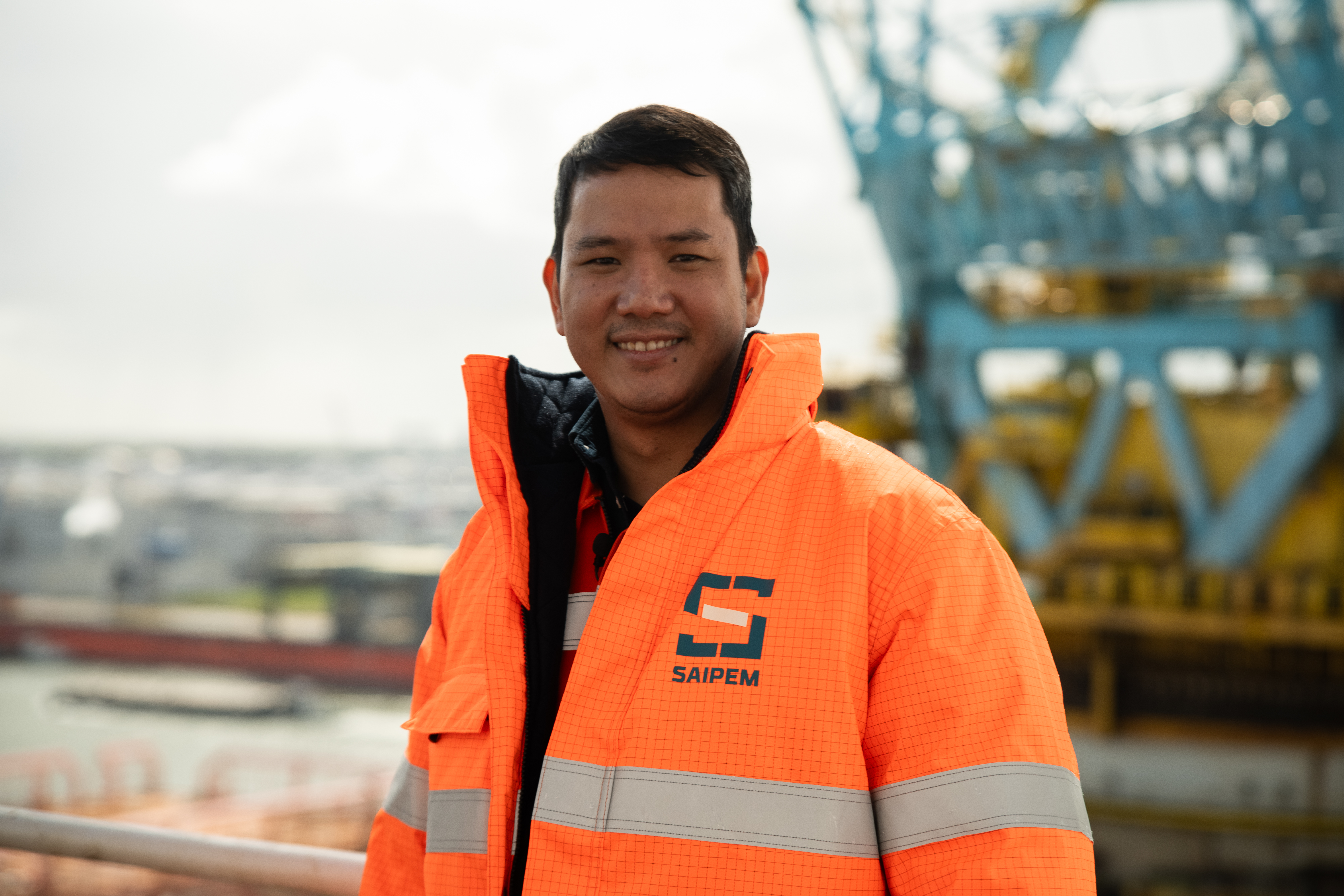
The Saipem 7000 has been working in recent years to install wind projects in the North Sea and is part of a programme seeking to reduce its emissions through monitoring and best practices. Chief Mate DP James Derick Alfonso shares more about the ship’s double role in the energy transition in this story.
Discover more