

Cybersecurity and Fraud Alert
Cybersecurity and fraud prevention: what to watch out for
Cybersecurity
Cybersecurity is increasingly becoming a crucial component for protecting Saipem's know-how and business operations. With the rise of global cyber threats, it is essential to adopt a proactive approach to prevent attacks and mitigate risks. Data protection not only safeguards corporate information but also maintains the trust of clients and partners. Implementing advanced cybersecurity solutions is essential for maintaining the confidentiality, integrity, and availability of data and systems. Cybersecurity is not just a technical issue, but a strategic element that contributes to Saipem's long-term success and resilience. The collaboration of all involved parties is crucial to ensuring effective cybersecurity oversight.
Fraud Alert
Please be vigilant about fraudulent communications that misuse the names, logos, trademarks, and brand of Saipem Group companies, as well as the names of its executives. Saipem has been alerted to a significant increase in internet and email fraud attempts. These scams primarily aim to steal personal and financial information or request payments for false collaboration opportunities and fictitious business activities. Often, these fraud attempts involve the use of email domains that closely resemble the official Saipem one. However, any genuine communication from Saipem will only come from email addresses with the official @saipem.com domain. Similarly, the official Saipem website is www.saipem.com.
To identify these attempts and differentiate them from legitimate company communications, pay attention to the following points:
- Saipem will never request fees or payments during the supplier scouting or onboarding processes.
- Some individuals/entities are offering on behalf of Saipem false job opportunities asking for money, personal data or financial details from the applicants. Please, note that Saipem and its Affiliates recruit their human resources through specific procedures, selecting and hiring candidates adopting criteria of merit, ability and professionalism in all decisions concerning the recruitment of personnel and will never ask for money. Read more here.
- Carefully examine the sender's email address for any typos or other suspicious elements. For example: @salpem.com; @saipen.com, etc. If you have any doubts, verify the sender through open sources and try to contact them using different contact details than those provided in the suspicious communication.
- Carefully read the content of the communication. Fraudulent messages often contain typos, grammatical errors, and other inaccuracies.
- Carefully inspect any websites to ensure they have the original logo, font, and contact information. In general, avoid clicking on links if you have doubts about the sender.
- Be wary of communications that require urgent action and those that do not allow you to contact Saipem through its legitimate and official communication channels.
- Rely solely on the contacts listed on the official Saipem website, as fraudsters may include phone numbers, websites, and e-mail addresses under their control in the message.
- Carefully evaluate the content of the message. If it requests information such as access codes, financial details, or credit card numbers, do not respond to the message.
Ongoing cases 
Spear Phishing Campaign Aimed at Malware Distribution
Saipem has become aware of a spear phishing campaign being conducted by unknown individuals targeting third-party companies and organizations, with the aim of distributing malware through fraudulent communications that unlawfully exploit the Saipem name and brand.
The malicious communications contain references to procurement procedures and requests for quotations and include compressed attachments apparently related to tender documentation.
Opening the attached files or downloading the content referenced in the communications may result in the compromise of the device being used.
The fraud is specifically characterized by the distribution of emails that simulate business communications related to Requests for Quotation (RFQs) and use email addresses that appear to be associated with Saipem. Among the addresses identified are, by way of example, iftikharhusain.shaikh@saipem.com, sherwin.banasig@saipem.com, and abdulaziz.alhussain@saipem.com.
It should be noted that the above-mentioned addresses do not belong to Saipem employees and are in no way associated with Saipem personnel. Investigations have also confirmed that such communications do not originate from Saipem systems, but are instead sent through compromised external infrastructures in order to falsely attribute the communications to Saipem and increase their credibility in the eyes of recipients (spoofing).
It should also be noted that, in this context, verifying the sender’s domain alone (@saipem.com) is not sufficient to guarantee the authenticity of a communication.
To gain greater assurance regarding the authenticity of received communications, the adoption of appropriate email security measures is strongly recommended, including the implementation of SPF, DKIM and DMARC* authentication mechanisms, which are recognized as industry best practices for protection against email-based fraud. Such controls should, however, be complemented by careful evaluation of the content of received communications and by the strengthening of user awareness initiatives, as more sophisticated fraudulent campaigns are specifically designed to appear highly credible.
We urge everyone to exercise utmost caution when receiving unexpected communications relating to tenders, commercial offers or Requests for Quotation (RFQs), and not to download or open suspicious files or documents.
For any doubts or reports, please immediately send an email to report.cyberevent@saipem.com attaching, if possible, the email received.
* Sender Policy Framework (SPF): a DNS TXT record that specifies the IP addresses authorized to send email on behalf of a domain.
DomainKeys Identified Mail (DKIM): adds a cryptographic digital signature to email headers (public key published in DNS, private key stored on the sending server).
Domain‑based Message Authentication, Reporting, and Conformance (DMARC): a DNS‑published policy that leverages SPF and DKIM to instruct receiving mail servers on how to handle unauthenticated messages.
Why these controls are essential
- Security: prevent malicious actors from impersonating the domain (spoofing).
- Reputation: improve sender reputation and reduce the risk of emails being flagged as spam
- Deliverability: major email service providers require these configurations to ensure reliable message delivery.
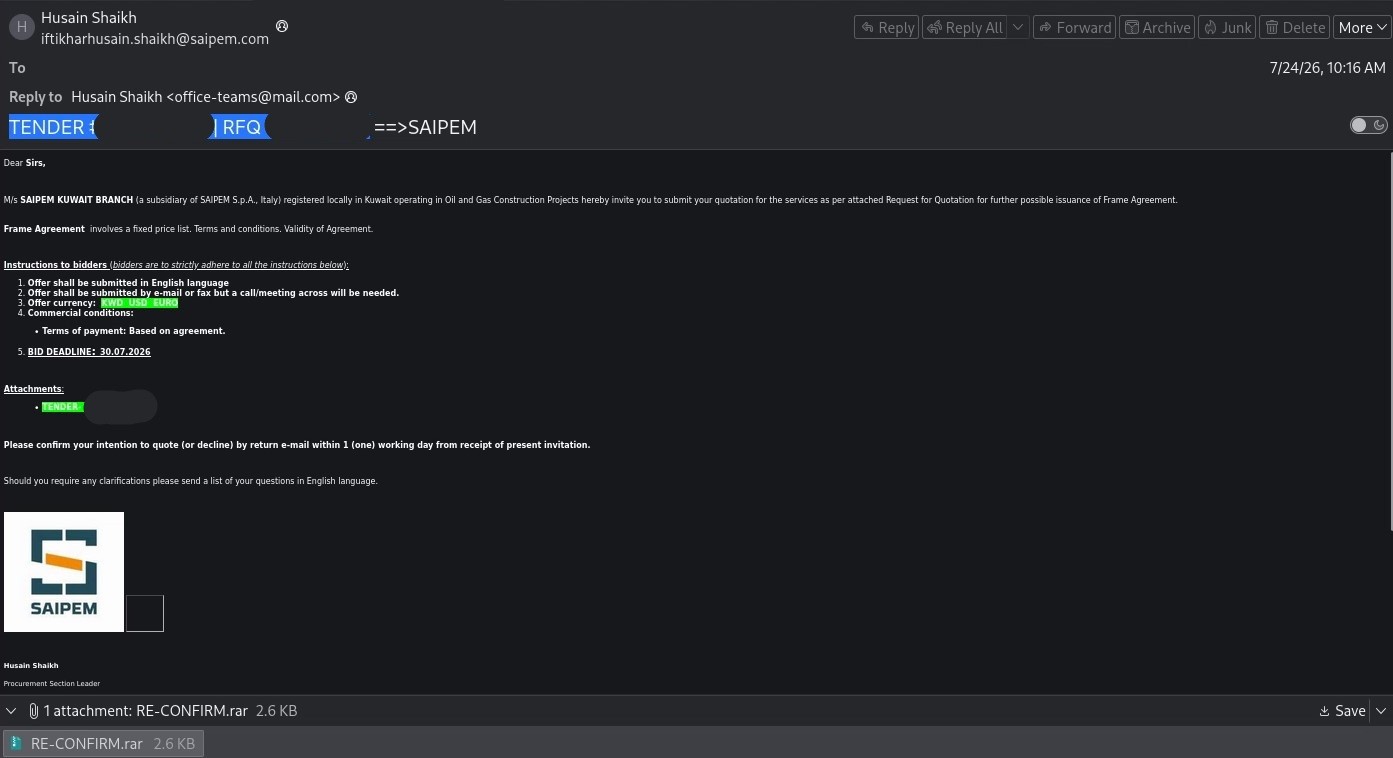
Saipem has become aware of a spear phishing campaign being conducted by unknown individuals targeting third-party companies.
This ongoing fraud is characterized by the sending of emails from addresses associated both with domains that are clearly not linked to Saipem (such as, for example, @ubiquesolutions.com, @ftsuae.com, @jafarabia.net, @ainalsaker.com, tcal.ae), and with domains that imitate Saipem’s real domain (@saipem.com) through slight spelling variations (e.g. @sa[l]pem.com).
In some cases, malicious actors also use email addresses that appear to be associated with Saipem (including addresses with the @saipem.com domain), by manipulating or falsifying communications in order to deceive recipients.
It should be noted that, in this context, verifying the sender’s domain alone (@saipem.com) is not sufficient to guarantee the authenticity of the communication.
To ensure that an email genuinely originates from Saipem, the adoption of appropriate email security measures is strongly recommended. These include the implementation of SPF, DKIM, and DMARC authentication mechanisms*, which are recognized as industry best practices for protection against email‑based fraud, as well as the reinforcement of user awareness and training initiatives.
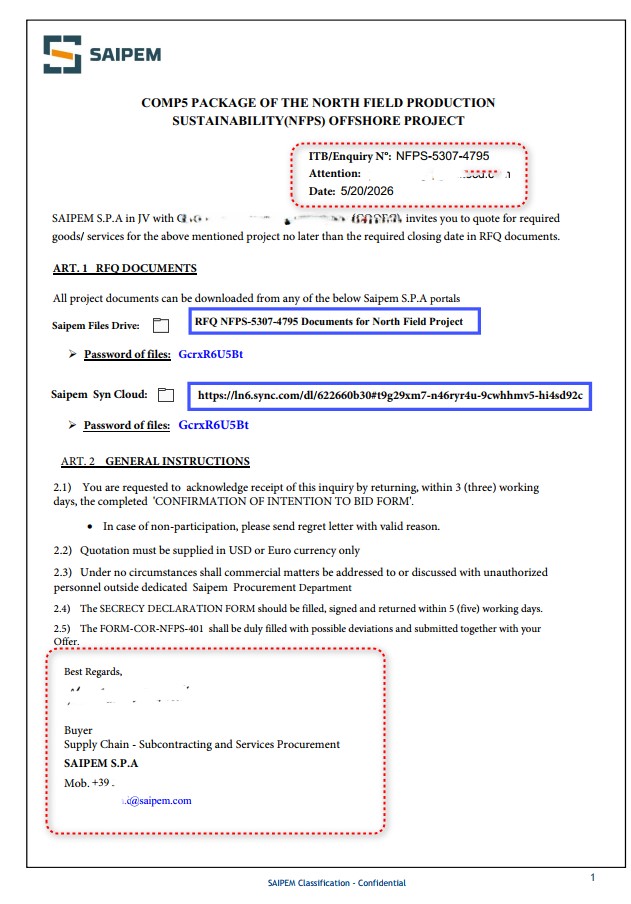
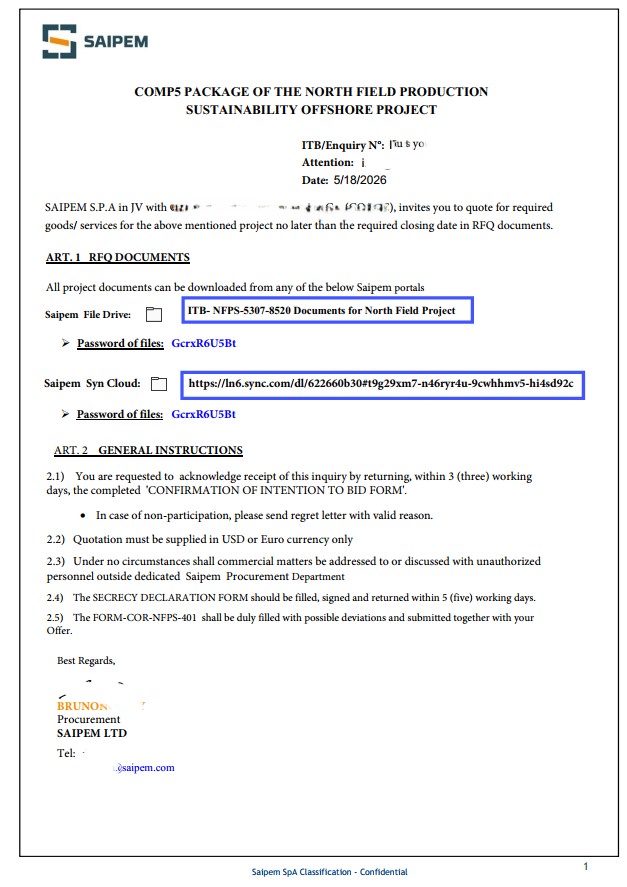
These malicious communications, sent through artificially crafted email addresses, unlawfully use the names of actual, unsuspecting Saipem employees and include attached .pdf files bearing the Saipem logo.
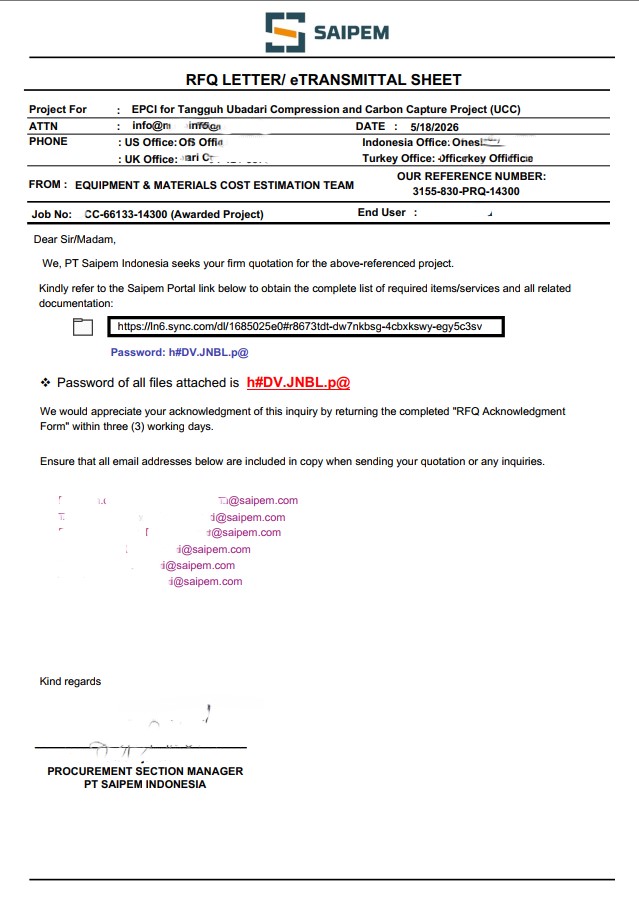
Under the pretext of requesting participation in a Request for Quotation (RFQ), recipients of these communications are fraudulently induced to view the .pdf file and download the necessary documentation to participate in the project via the malicious links contained in the file.
Warning: accessing the links and the password protected .zip file contained within leads to the compromise of the user's computer due to a trojan carried by the downloaded documents.
We urge everyone to exercise utmost caution and not to download or open suspicious documents. For any doubts or reports, please immediately send an email to report.cyberevent@saipem.com attaching, if possible, the email received.
* Sender Policy Framework (SPF): a DNS TXT record that specifies the IP addresses authorized to send email on behalf of a domain.
DomainKeys Identified Mail (DKIM): adds a cryptographic digital signature to email headers (public key published in DNS, private key stored on the sending server).
Domain‑based Message Authentication, Reporting, and Conformance (DMARC): a DNS‑published policy that leverages SPF and DKIM to instruct receiving mail servers on how to handle unauthenticated messages.
Why these controls are essential
- Security: prevent malicious actors from impersonating the domain (spoofing).
- Reputation: improve sender reputation and reduce the risk of emails being flagged as spam
- Deliverability: major email service providers require these configurations to ensure reliable message delivery.
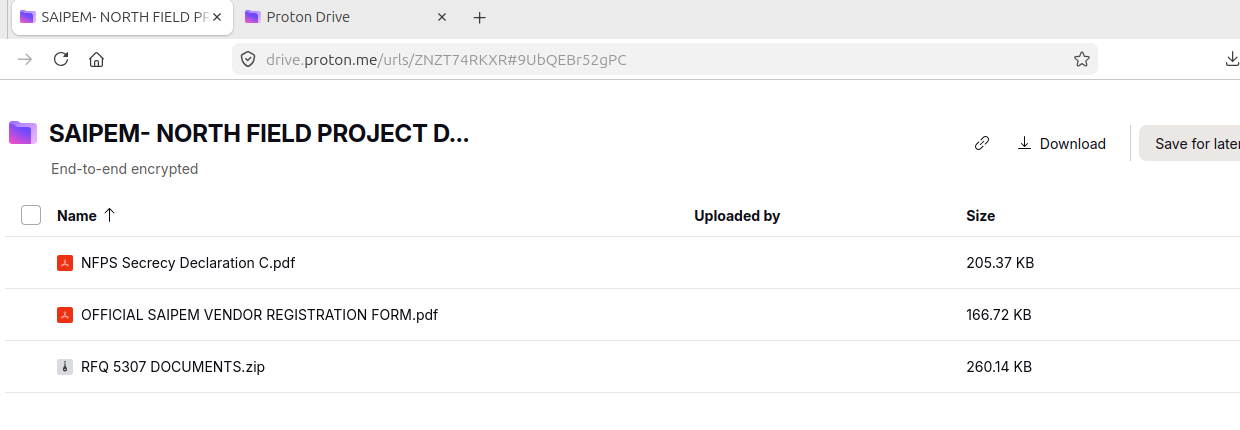
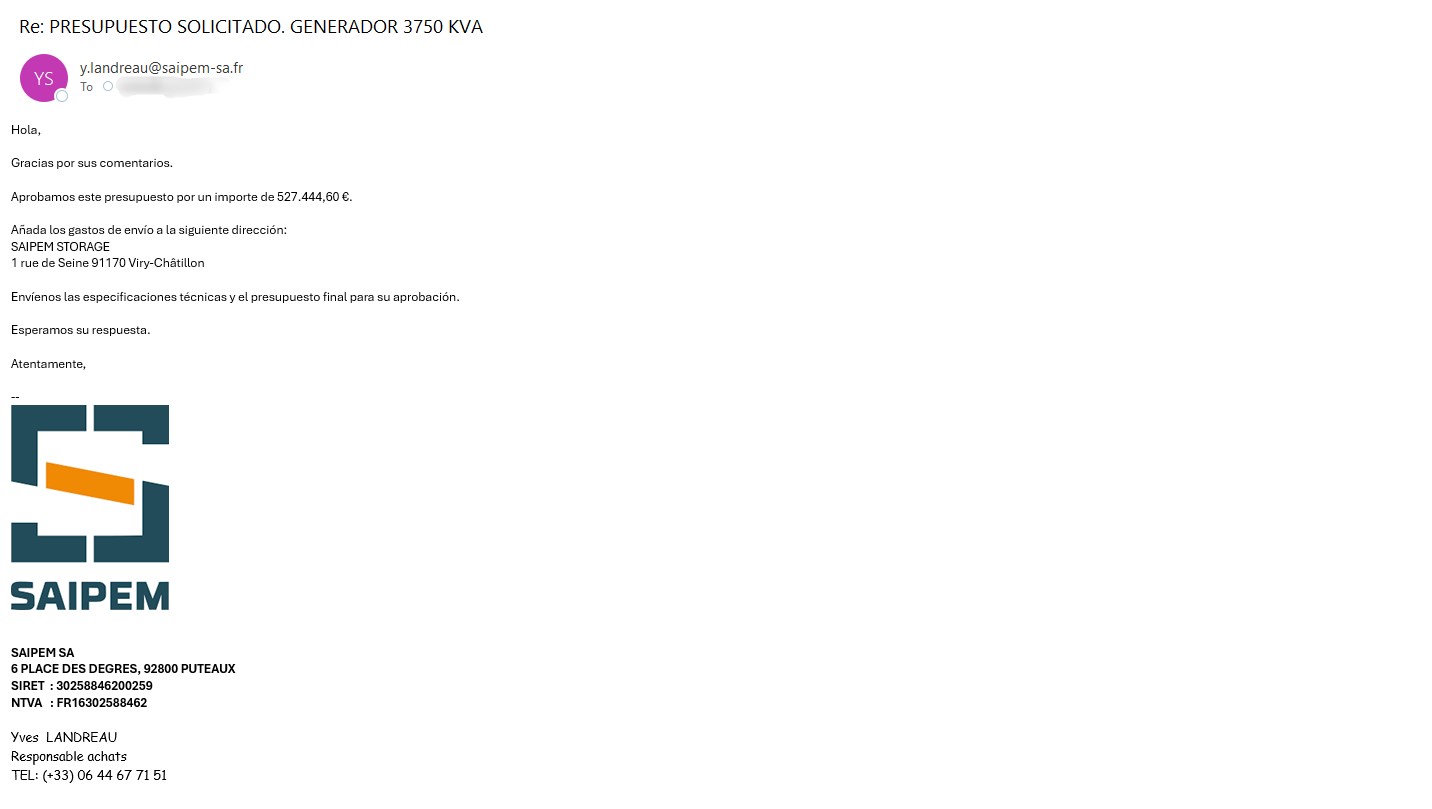
Saipem has become aware of a fraud attempt being conducted by unknown individuals targeting third-party companies, concerning an alleged supply of materials improperly carried out in Saipem’s name.
The fraud was perpetrated through the transmission of communications originating from email addresses and domains artificially similar to Saipem’s official ones, including addresses associated with the domain saipem‑sa.fr, used to simulate apparently legitimate commercial exchanges. The Saipem logo was also improperly used as part of the email signature.
Through such communications, the recipients were induced to proceed with the supply and delivery of goods to a location that does not correspond to any Saipem Group office (e.g. 1, Rue de Seine, 91170 – Viry‑Chatillon), with a request to invoice the commercial transaction to Saipem, which was in fact completely unaware of the transaction.
While Saipem is continuously engaged in the takedown of web domains unlawfully exploiting the Saipem brand, utmost caution is recommended in verifying the authenticity of sender email addresses. Please bear in mind that all official communications from Saipem originate exclusively from email addresses ending with the official domain @saipem.com.
Saipem strongly recommends exercising the utmost caution when assessing the authenticity of communications that make reference to its name, brand or alleged commercial activities. It is recalled that any request relating to supplies, deliveries or payments must take place exclusively through the Company’s official channels.
Saipem has recently become aware of a phishing campaign being conducted by unknown individuals targeting third-party companies.
The ongoing fraud illicitly uses the Saipem name and brand, including references to the name of a Saipem employee (name.surname@saipem.com), in order to make the fraudulent communications appear more credible.
These messages leverage sender spoofing techniques and contain links to malicious websites designed to harvest login credentials from the targeted organizations.
It should be noted that, in this context, verifying the sender’s domain alone (@saipem.com) is not sufficient to guarantee the authenticity of the communication.
To ensure that an email genuinely originates from Saipem, the adoption of appropriate email security measures is strongly recommended. These include the implementation of SPF, DKIM, and DMARC authentication mechanisms*, which are recognized as industry best practices for protection against email‑based fraud, as well as the reinforcement of user awareness and training initiatives.
Saipem strongly urges all external parties to exercise the utmost caution.
Please report immediately any fraudulent communication by sending an email to report.cyberevent@saipem.com attaching, if possible, the email received.
* Sender Policy Framework (SPF): a DNS TXT record that specifies the IP addresses authorized to send email on behalf of a domain.
DomainKeys Identified Mail (DKIM): adds a cryptographic digital signature to email headers (public key published in DNS, private key stored on the sending server).
Domain‑based Message Authentication, Reporting, and Conformance (DMARC): a DNS‑published policy that leverages SPF and DKIM to instruct receiving mail servers on how to handle unauthenticated messages.
Why these controls are essential
- Security: prevent malicious actors from impersonating the domain (spoofing).
- Reputation: improve sender reputation and reduce the risk of emails being flagged as spam
- Deliverability: major email service providers require these configurations to ensure reliable message delivery.
Saipem has become aware of a spear phishing campaign being conducted by unknown individuals targeting third-party companies.
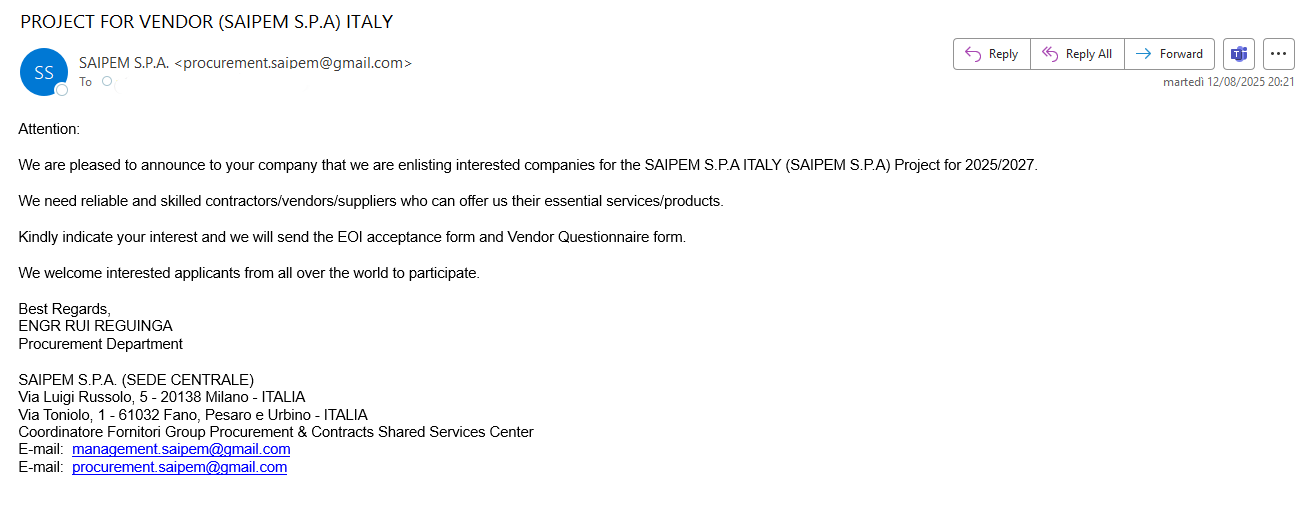
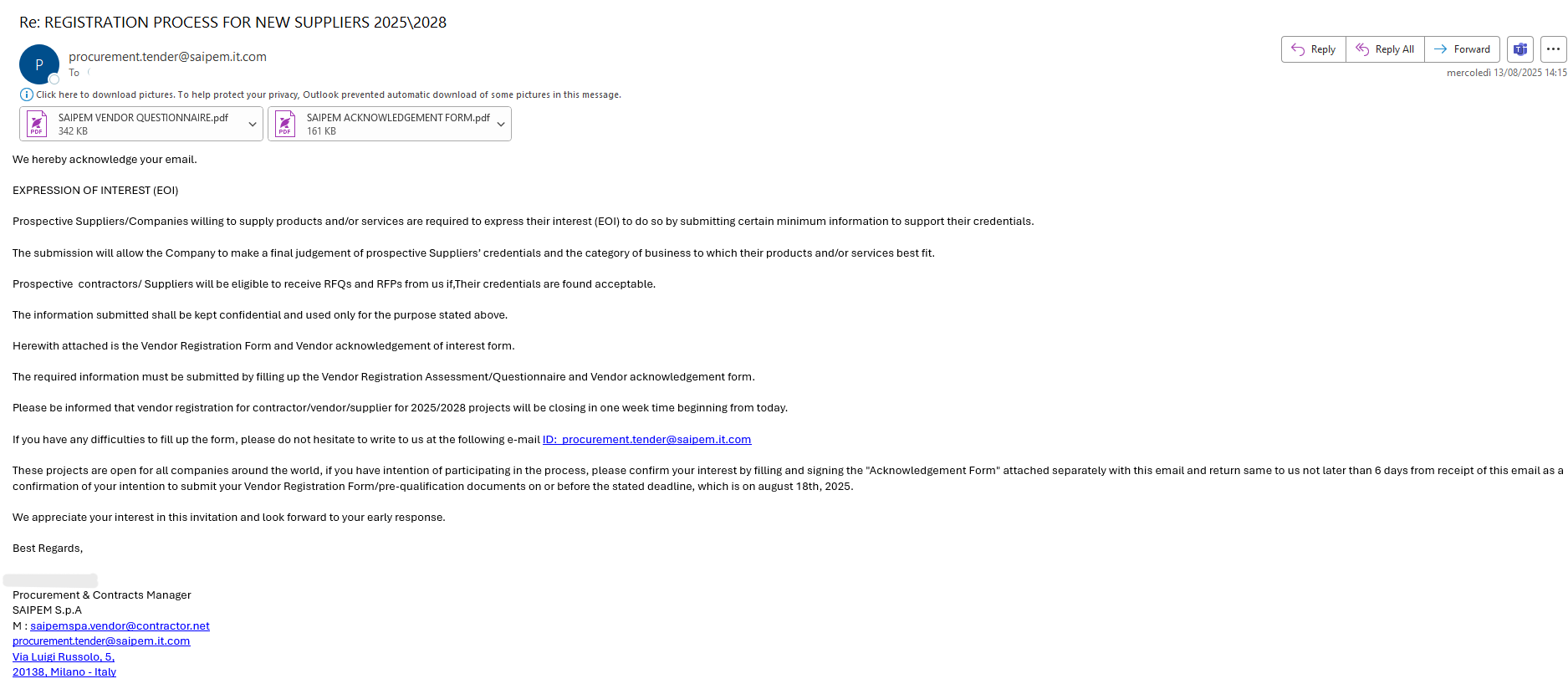
The ongoing fraud is characterized by the sending of emails from addresses and domains that are deceptively similar to Saipem’s official ones. So far, the use of the following domains has been detected @saipamspat.com, @siapemspa.com, @saipemspet.com, @salpemspa.com, @saipemspait.com, @saipemspa.com, @saipem-spa.com, @spasaipem.com, together with the addresses procurement.saipem@gmail.com, vendorprocurement.saipem-spa@outlook.com, saipemspa.vendor@contractor.net, saipemspa.vendor@contractor.net, procurement.tender@saipem.it.com, and management.saipem@gmail.com
While Saipem is continuously engaged in the takedown of web domains unlawfully exploiting the Saipem brand, utmost caution is recommended in verifying the authenticity of sender email addresses. Please bear in mind that all official communications from Saipem originate exclusively from email addresses ending with the genuine domain @saipem.com
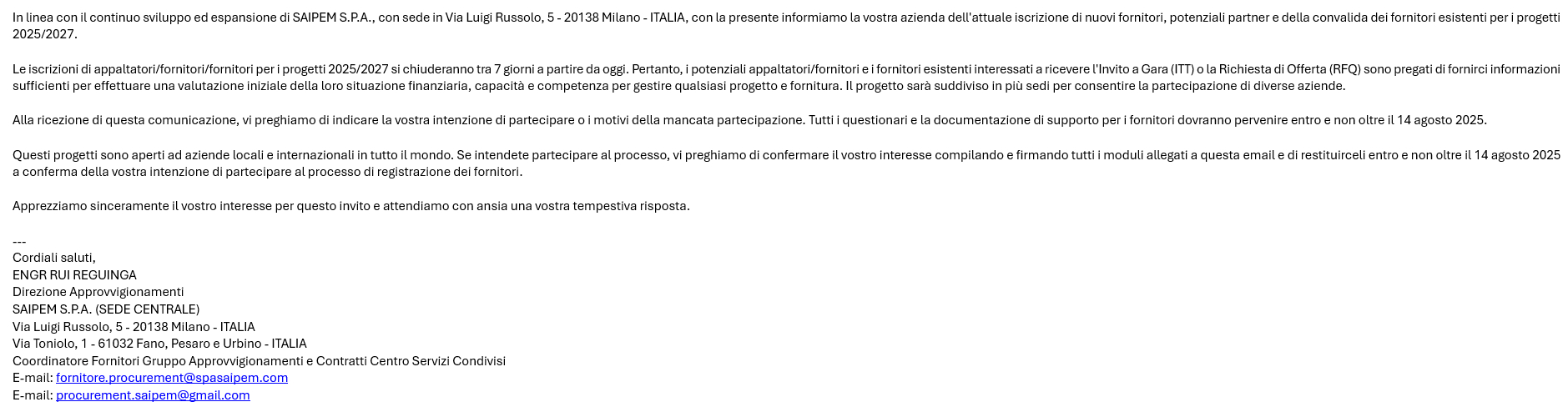
These malicious communications, despite the fake email addresses, include attached .pdf files bearing the Saipem logo. Under the pretext of requesting the registration of new suppliers in Saipem’s Vendor Register and validating the existing ones for the 2025/2027 projects, recipients of these communications are fraudulently induced to complete the questionnaire in the attached .pdf file and disclose potentially sensitive and confidential information.
Please be reminded not to download attachments or click on links from suspicious email addresses.
Based on the information received by Saipem, it is possible that, during the communications, the perpetrators of the fraud may request monetary payments for the alleged registration of the targeted company in Saipem’s Vendor Register. Please bear in mind that Saipem will never request fees or payments during the supplier scouting or onboarding processes.
Below is reported a sample of the fraudulent communication.
Please report immediately any fraudulent communication by sending an email to report.cyberevent@saipem.com attaching, if possible, the email received.
Saipem has become aware of a spear phishing campaign being conducted by unknown individuals targeting third-party companies.
This ongoing fraud is characterized by the sending of emails from addresses associated with domains that are clearly not linked to Saipem. For example, the email addresses enquiry@sagamaxservices.com.my and zainudin@nesasinar.com are being used, while it is important to note that all official Saipem communications come exclusively from email addresses ending with the genuine domain @saipem.com.
These malicious communications, despite the fake email addresses, unlawfully use the names of actual, unsuspecting Saipem employees and include attached .pdf files bearing the Saipem logo.
Under the pretext of requesting participation in a Request for Quotation (RFQ), recipients of these communications are fraudulently induced to view the .pdf file and download the necessary documentation to participate in the project via the malicious links contained in the file.
Warning: accessing the links and the password protected .zip file contained within leads to the compromise of the user's computer due to a trojan carried by the downloaded documents.
We urge everyone to exercise utmost caution and not to download or open suspicious documents. For any doubts or reports, please immediately send an email to report.cyberevent@saipem.com attaching, if possible, the email received.
Types of cyber attacks
It is a type of attack that involves sending malicious emails specifically designed to trick victims into revealing banking information, access credentials, or other sensitive data.
A form of phishing where an attacker uses a text message to trick recipients into clicking on a link, downloading malicious software onto a smartphone, or sharing confidential information
Social engineering encompasses a broad range of activities intended to exploit human error or human behaviour with the objective of gaining access to information or services. It uses various forms of manipulation to trick victims into making mistakes or handing over sensitive or secret information.
Spearphishing attacks are carried out by sending highly personalized messages that fraudsters craft using publicly gathered information about the victim.
Creation of messages with a spoofed sender address
Using intentional typos to deceive the recipient (e.g. salpem.com instead of saipem.com).
Vishing attacks use spoofed phone numbers, voice-altering software, fake text messages, and social engineering techniques to deceitfully obtain sensitive information from targeted users.
Deepfakes are files (photos, videos, and/or audio) generated by artificial intelligence software. These tools take real content and can recreate, with astonishing realism, the features or movements of a face or body, as well as accurately mimic a specific voice. This sophisticated technology has a high potential to deceive human perception, making it particularly dangerous when used to fraudulently exploit someone else's identity.
Documents